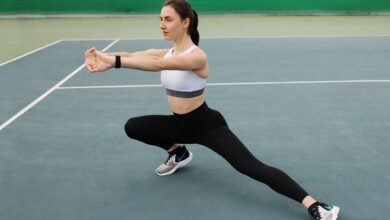
Daily Stretching Routine: The Complete Guide With 5, 10 and 15-Minute Plans


A good daily stretching routine should be short enough to actually do, gentle enough to repeat every day, and complete enough to cover your whole body. Most guides online manage only one of those three. Some give you five stretches and ignore your neck and wrists. Some only cover mornings. Some never tell you how long to hold a stretch or whether stretching every day is even safe.
This guide fixes that. Below you will find a full-body daily stretching routine with exact hold times, reps and order, in three lengths (5, 10 and 15 minutes), plus separate morning, daily stretching routine desk-break and evening versions, a 4-week progression plan, an honest answer on whether daily stretching is safe, an FAQ, and a printable checklist.
Quick Answer: What Is the Best Daily Stretching Routine?
The short version
- Time: 5 to 15 minutes a day. Even 5 minutes counts.
- Number of stretches: 7 (short plan) to 13 (full plan), working from neck to feet.
- Hold time: 30 seconds per side for most static stretches (up to 60 seconds for a stubborn tight area).
- Reps: 1 to 2 rounds per stretch. Dynamic moves: 8 to 10 slow reps.
- Frequency: Daily is fine if the stretching is gentle. The minimum for benefit is about 2 to 3 times a week.
- Golden rule: Feel a mild pull, never sharp pain. Never bounce.
- Best order: Warm up first (2 minutes of easy movement), then dynamic moves, then static holds.
Table of Contents
- Why a daily stretching routine is worth it
- Is it safe to stretch every day?
- Before you start: warm-up, static vs dynamic, and safety rules
- The full-body daily stretching routine (master table)
- How to do each stretch (with mistakes and easier/harder versions)
- The 5, 10 and 15-minute versions
- Morning daily stretching routine
- Daily stretching routine for desk workers
- Evening daily stretching routine
- Daily stretching routine for beginners: a 4-week plan
- Common mistakes and myths
- When to see a doctor or physical therapist
- Habit tracker and printable checklist
- FAQ
- Final takeaway, sources and disclaimer
1. Why a Daily Stretching Routine Is Worth It

Stretching has a clear, well-supported main benefit: it improves flexibility and range of motion. Mayo Clinic notes that flexible muscles support healthier joints and can make everyday movements, daily stretching routine such as reaching, bending and climbing stairs, feel easier. A short daily habit also does a few other useful things:
- It breaks up stillness. Long periods of sitting leave the hips, chest and neck feeling stiff. A few minutes of movement interrupts that.
- It builds body awareness. Doing the same stretches daily shows you which side is tighter and what changes from day to day.
- It supports posture. Chest and hip flexor stretches, combined with good habits, can help reduce the slumped, rounded position many people drift into.
- It can feel relaxing. Slow breathing during a stretch is a simple way to unwind, which is why an evening routine works well for many people.
What stretching will not do. Research on stretching is mixed in some areas, and it is better to be honest about it. A Cochrane review found that stretching before or after exercise makes little to no difference to muscle soreness afterward. Evidence that stretching reliably prevents injury is also limited. So think of stretching as a tool for flexibility, daily stretching routine comfort and movement quality, not a magic injury shield or a replacement for strength training and general activity.
2. Is It Safe to Stretch Every Day?
For most healthy adults, yes, as long as the stretching is gentle. Many guides skip this question, and the usual advice you will see is only that you should stretch at least 2 to 3 times a week. That is the minimum for results, not a limit.
Here is a practical way to think about it:
- Gentle stretching is low-risk to repeat daily. A mild pull, held steadily and breathed through, is not the kind of stress that needs a rest day.
- Overstretching is the real risk. Pushing into pain, bouncing, or forcing a deep stretch daily can irritate muscles, tendons and joints. If an area feels sore the next day, ease off or skip that stretch.
- Listen to the signals. A mild, easing pull is normal. Sharp pain, pinching in a joint, numbness or tingling are signs to stop.
- Some people should check first. If you have a recent injury, a joint condition, hypermobility, osteoporosis, are pregnant, or are recovering from surgery, ask your doctor or physical therapist which stretches suit you.
A good rule: Aim for a daily habit, but let the intensity float. Some days, 5 easy minutes is perfect. Other days, you may do the full 15. The goal is consistency, not a daily personal best.
3. Before You Start

Warm up first
Stretching cold muscles hard is a common mistake. Spend about 2 minutes warming up: march on the spot, do arm circles, take a brisk walk around the house, or do a few easy squats. You are aiming to feel slightly warmer, not tired.
Static vs dynamic stretching
These two types do different jobs, and a good routine uses both.
| Dynamic stretching | Static stretching | |
|---|---|---|
| What it is | Controlled, flowing movement through a range | Holding a stretched position without moving |
| Typical timing | 8 to 10 slow reps | 20 to 30 seconds (up to 60) per side |
| Best used | At the start, as part of the warm-up | After warming up, or at the end of the day |
| Examples in this guide | Shoulder rolls, cat-cow, chin tuck | Hamstring, quad, calf, chest, hip flexor |
A simple order: warm-up, dynamic moves, then static holds. In the evening, you can go straight to static holds because the body is already warm from the day.
Safe stretching rules
- Never bounce. Ease into each position and hold it steadily.
- Mild pull only. Aim for about a 4 to 6 out of 10 stretch sensation, never sharp pain.
- Breathe. Slow, steady breaths help you relax into the stretch. Do not hold your breath.
- Hold 30 seconds. Per Mayo Clinic, a 30-second hold is a good target, and up to 60 seconds helps problem areas.
- Stretch both sides. Match the time on each side, and spend a little extra on the tighter one.
- Move slowly out of every stretch. Do not snap out of the position.
4. The Full-Body Daily Stretching Routine (Master Table)
This is the complete routine, working from the top of the body to the bottom so no major muscle group is missed. Use the full table for the 15-minute plan, or pick from it using the shorter plans in section 6.
| # | Stretch | Target area | Type | Hold / reps | Time (approx.) |
|---|---|---|---|---|---|
| 1 | Chin tuck | Neck, upper back | Dynamic | 8 reps, 2-sec hold | 30 sec |
| 2 | Neck side tilt | Side of neck, upper traps | Static | 20 to 30 sec per side | 1 min |
| 3 | Shoulder rolls | Shoulders, upper back | Dynamic | 8 forward, 8 back | 30 sec |
| 4 | Cross-body shoulder stretch | Rear shoulder | Static | 20 to 30 sec per side | 1 min |
| 5 | Doorway chest stretch | Chest, front shoulder | Static | 30 sec | 30 to 45 sec |
| 6 | Wrist flexor and extensor stretch | Forearms, wrists | Static | 20 sec each direction, each wrist | 1 min 20 sec |
| 7 | Cat-cow | Spine, core | Dynamic | 8 to 10 slow reps | 45 sec |
| 8 | Child’s pose | Lower back, lats, hips | Static | 30 to 45 sec | 45 sec |
| 9 | Lying spinal twist | Lower back, glutes | Static | 30 sec per side | 1 min |
| 10 | Half-kneeling hip flexor stretch | Front of hip, thigh | Static | 30 sec per side | 1 min |
| 11 | Figure-four stretch | Glutes, outer hip | Static | 30 sec per side | 1 min |
| 12 | Standing hamstring stretch | Back of thigh | Static | 30 sec per side | 1 min |
| 13 | Standing quad stretch | Front of thigh | Static | 30 sec per side | 1 min |
| 14 | Wall calf stretch | Calves, Achilles | Static | 30 sec per side | 1 min |
Total: about 13 to 15 minutes including transitions, plus 2 minutes for a warm-up.
5. How to Do Each Stretch
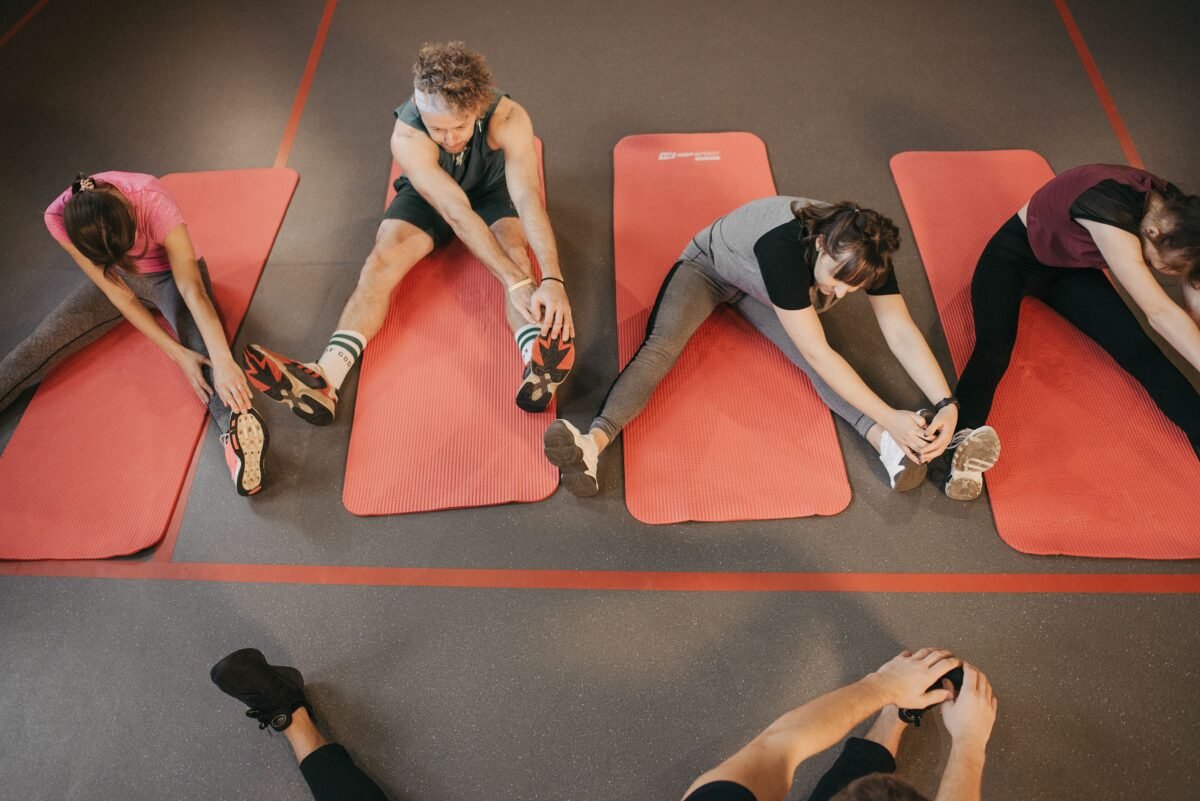
For each stretch you will find how to do it, what you should feel, the most common mistake, and an easier and harder version.
1. Chin tuck (neck and upper back)
How: Sit or stand tall. Gently draw your chin straight back, as if making a double chin, without tilting your head down. Hold for 2 seconds, then release. Repeat 8 times. You should feel: A mild stretch at the base of the skull and back of the neck. Common mistake: Nodding the head down instead of sliding it straight back. Easier: Do it lying on your back with your head resting on a pillow. Harder: Add a gentle pressure with two fingers on your chin.
2. Neck side tilt
How: Sit tall with your shoulders relaxed. Slowly lower your right ear toward your right shoulder. Hold 20 to 30 seconds, then switch. You should feel: A pull along the opposite side of the neck. daily stretching routine Common mistake: Lifting the shoulder up toward the ear. Keep it down. Easier: Smaller tilt, 15 seconds. Harder: Rest your same-side hand lightly on your head. Do not pull, only let the weight of the hand help.
3. Shoulder rolls
How: Stand or sit tall. Lift your shoulders toward your ears, roll them back and down in a smooth circle. Do 8 reps, then reverse for 8 reps. You should feel: Looseness across the shoulders and upper back. Common mistake: Moving too fast. Slow circles are more effective. Easier: Smaller circles. Harder: Add arm circles with your arms out to the sides.
4. Cross-body shoulder stretch
How: Bring your right arm across your chest at shoulder height. Use your left hand to hold it just above the elbow. Hold 20 to 30 seconds, then switch. You should feel: A stretch at the back of the shoulder. daily stretching routine Common mistake: Twisting the torso or pressing on the elbow joint itself. Easier: Let the arm hang lower, nearer to the stomach. Harder: Turn your head gently away from the stretching arm.
5. Doorway chest stretch
How: Stand in a doorway with your forearm on the frame, elbow bent at 90 degrees, at about shoulder height. Step forward slightly until you feel a stretch across the chest. Hold 30 seconds. Try one arm at a time, or both at once. You should feel: A stretch across the chest and front of the shoulder. Common mistake: Arching the lower back. Keep your ribs down and core lightly engaged. Easier: Lower the elbow below shoulder height and step forward less. Harder: Raise the arm slightly higher, or turn your body gently away.
6. Wrist flexor and extensor stretch
How: Extend your right arm in front of you, palm up. With your left hand, gently pull your fingers down toward the floor. Hold 20 seconds. Then turn your palm down and gently press the back of the hand toward you for 20 seconds. Repeat on the other side. You should feel: A stretch along the inside, then the outside, of the forearm. daily stretching routine Common mistake: Bending the elbow or pulling the fingers too hard. This is a gentle stretch. Easier: Keep the elbow slightly bent. Harder: Fully straighten the elbow and extend the stretch to 30 seconds.
7. Cat-cow (spine)
How: On hands and knees, with wrists under shoulders and knees under hips, inhale as you drop your belly and lift your chest and tailbone (cow). Exhale as you round your back and tuck your chin (cat). Move slowly for 8 to 10 rounds. You should feel: A gentle wave of movement along the spine. Common mistake: Rushing. Match each movement to a breath. Easier: Do it seated, with hands on your knees. Harder: Add a pause at the end of each position.
8. Child’s pose
How: From hands and knees, sit your hips back toward your heels and reach your arms forward, resting your forehead on the floor or a pillow. Hold 30 to 45 seconds, breathing into your lower back. You should feel: A lengthening through the back, hips and sides. Common mistake: Forcing the hips down when the knees feel tight. Place a cushion between your hips and heels instead. Easier: Widen your knees, or place a pillow under your chest. Harder: Walk both hands to one side to stretch the opposite side of the torso.
9. Lying spinal twist
How: Lie on your back with your knees bent. Drop both knees gently to the right side while keeping your shoulders on the floor and your arms out to the sides. Hold 30 seconds, then switch. You should feel: A gentle rotation through the lower back and outer hip. Common mistake: Forcing the knees to the floor. Let gravity do the work, and support them with a pillow if needed. Easier: Keep the knees higher, supported by a pillow. Harder: Straighten the top leg.
10. Half-kneeling hip flexor stretch
How: Kneel on your right knee (pad it with a towel), with your left foot flat in front. Tuck your tailbone slightly and gently shift your weight forward until you feel a stretch at the front of your right hip. Hold 30 seconds, then switch. You should feel: A stretch at the front of the hip and top of the thigh. Common mistake: Arching the lower back. A small pelvic tuck gives a better stretch. Easier: Shift forward less. Harder: Raise the arm on the kneeling side overhead and lean gently away.
11. Figure-four stretch (glutes)
How: Lie on your back with your knees bent. Cross your right ankle over your left thigh. Pull your left thigh gently toward your chest until you feel a stretch in the right glute. Hold 30 seconds, then switch. You should feel: A deep stretch in the buttock and outer hip. Common mistake: Letting the lower back lift. Keep it flat on the floor. Easier: Keep your foot on the floor and only cross the ankle over the knee. Harder: Pull the thigh closer to your chest.
12. Standing hamstring stretch
How: Stand tall and place your right heel on a low step or the floor in front of you, with the toes pointing up. Keep the leg straight but not locked. Hinge forward from the hips with a flat back until you feel a stretch behind the thigh. Hold 30 seconds, then switch. You should feel: A pull behind the thigh, not behind the knee. Common mistake: Rounding the back to reach the toes. Hinge from the hips instead. Easier: Bend the standing knee slightly or keep the heel on the floor. Harder: Use a higher surface.
13. Standing quad stretch
How: Stand tall, holding a wall or chair for balance. Bend your right knee and bring your heel toward your glute. Hold your ankle with your right hand, keep your knees close together, and gently tuck your pelvis. Hold 30 seconds, then switch. You should feel: A stretch along the front of the thigh. Common mistake: Letting the knee drift out to the side or the back arch. Easier: Use a towel or strap around the ankle. Harder: Push the hips slightly forward.
14. Wall calf stretch
How: Stand facing a wall with your hands on it. Step your right foot back, keeping the heel down and the leg straight. Lean toward the wall until you feel a stretch in the calf. Hold 30 seconds, then switch. To target the lower calf and Achilles, bend the back knee slightly. You should feel: A pull in the calf of the back leg. Common mistake: Lifting the heel or turning the toes out. Easier: Take a smaller step back. Harder: Step further back, or stretch with the toes up the wall.
6. The 5, 10 and 15-Minute Versions
Not every day is the same. Choose the version that fits your day, and do not feel guilty about picking the short one.
5-minute daily stretching routine (busy-day version)
Perfect when time is tight. Seven stretches, about 5 minutes.
| Stretch | Time |
|---|---|
| Chin tuck | 8 reps |
| Neck side tilt | 20 sec per side |
| Cross-body shoulder stretch | 20 sec per side |
| Doorway chest stretch | 30 sec |
| Cat-cow | 8 reps |
| Half-kneeling hip flexor stretch | 30 sec per side |
| Wall calf stretch | 20 sec per side |
10-minute daily stretching routine (standard version)
The 5-minute set above, plus these extras. Use 30-second holds.
- Shoulder rolls (8 each way, as a warm-up)
- Wrist stretches (20 sec each direction)
- Child’s pose (30 sec)
- Figure-four stretch (30 sec per side)
- Standing hamstring stretch (30 sec per side)
15-minute daily stretching routine (full-body version)
Use the full master table from section 4: all 14 stretches, with a 2-minute warm-up first. Do this on your more relaxed days, such as weekends, or as an evening wind-down.
Which one should I choose? If you can only do one thing, do the 5-minute version every day instead of the 15-minute version once a week. Consistency beats length.
7. Morning Daily Stretching Routine
Muscles and joints often feel stiffer first thing after waking. Keep morning stretching gentle: skip deep, forceful stretches and focus on easy movement that wakes the body up.
Do this (about 6 minutes):
- Lying spinal twist, 30 seconds per side, still in bed if you like
- Cat-cow, 8 slow reps
- Child’s pose, 30 seconds
- Shoulder rolls, 8 each way
- Chin tuck, 8 reps
- Standing hamstring stretch, 20 seconds per side
- Wall calf stretch, 20 seconds per side
Tip: Drink some water first, take a few deep breaths, and keep every hold shorter and softer than you would later in the day.
8. Daily Stretching Routine for Desk Workers
This one is the most overlooked version, and one of the most useful. Sitting for hours tightens the hip flexors, chest, neck and wrists, exactly where desk workers feel it. You can do this at your desk in 3 minutes, every 1 to 2 hours.
- Chin tucks: 8 reps
- Neck side tilt: 15 to 20 seconds per side
- Shoulder rolls: 8 each way
- Seated chest opener: Clasp your hands behind your chair back, lift your chest, and hold 20 seconds
- Wrist stretches: 20 seconds each direction, each wrist
- Seated figure-four: Cross an ankle over the opposite knee, sit tall, and hinge forward slightly for 30 seconds per side
- Standing hip flexor stretch or a short walk: 30 seconds per side
Bonus habit: Set a phone reminder every hour. Even standing up for a minute helps.
9. Evening Daily Stretching Routine
Your body is warm by evening, so you can hold the stretches a little longer. Keep the lights low, breathe slowly, and avoid rushing. Many people find this helps them wind down before bed.
Do this (about 10 minutes):
- Doorway chest stretch, 30 seconds
- Standing quad stretch, 30 seconds per side
- Figure-four stretch, 30 to 45 seconds per side
- Half-kneeling hip flexor stretch, 30 seconds per side
- Lying spinal twist, 30 to 45 seconds per side
- Child’s pose, 45 to 60 seconds
Finish with 5 slow breaths, lying on your back with your legs resting up a wall or on a chair, if that is comfortable for you.
10. Daily Stretching Routine for Beginners: A 4-Week Plan
If you are new to stretching, or feel very stiff, start small. A gradual build avoids soreness and builds a habit.
| Week | Daily time | What to do | Focus |
|---|---|---|---|
| Week 1 | 5 min | 5-minute routine, 15-second holds | Learn the moves, stay gentle |
| Week 2 | 5 to 7 min | 5-minute routine, 20 to 30-second holds | Build the habit, same time each day |
| Week 3 | 10 min | 10-minute routine, 30-second holds | Add hips, hamstrings and wrists |
| Week 4 | 10 to 15 min | 10 or 15-minute routine, 1 to 2 rounds | Spend extra time on your tightest area |
7-day starter schedule (Week 1):
- Day 1: Neck and shoulders
- Day 2: Chest and upper back
- Day 3: Hips
- Day 4: Legs (hamstrings, quads, calves)
- Day 5: Spine (cat-cow, child’s pose, twist)
- Day 6: Full 5-minute routine
- Day 7: Easy day, short stretch or a walk
How to know you are progressing: Test yourself once a week. For example, note how far you can reach in a seated forward fold, how comfortably you can look over your shoulder, or how your hips feel after sitting. Small improvements over 3 to 4 weeks are a good sign. Do not expect miracles in a few days.
Modifications for stiff or older adults:
- Use a chair for balance and do stretches seated where possible
- Use a strap or towel for hamstring and quad stretches
- Shorten holds to 15 to 20 seconds and build up
- Skip kneeling positions if your knees object
- Stretch after a warm shower, when muscles feel looser
11. Common Mistakes and Myths
Mistakes that spoil a routine
- Bouncing. It can trigger the muscle’s protective reflex and increase the risk of strain.
- Stretching into pain. More pain does not mean more benefit.
- Holding your breath. It increases tension.
- Only stretching the tight spot. Often, the cause is elsewhere. Tight hips can contribute to lower-back stiffness, for example.
- Skipping the warm-up. Cold muscles are less cooperative.
- Comparing yourself with others. Flexibility varies widely by body structure.
Myths
- “You must touch your toes.” No. Reaching your toes is not the goal. Comfortable movement is.
- “Stretching prevents all injuries.” The evidence is mixed. It is one tool alongside strength, warm-ups and sensible training.
- “No pain, no gain.” For stretching, this is wrong. Pain is a warning.
- “Stretching cures soreness.” Research suggests it makes little difference to muscle soreness after exercise.
- “Stretching only matters for athletes.” Everyday movement benefits from flexibility too.
- “More is better.” Beyond a point, intensity does not add benefit and increases the chance of irritation.
12. When to See a Doctor or Physical Therapist
Stretching is not a treatment for every ache. Please get professional advice if you have:
- Sharp, sudden or worsening pain during or after stretching
- Numbness, tingling or weakness in an arm or leg
- Swelling, bruising or a joint that feels unstable
- Pain that lasts more than a week or two without improving
- A recent injury, fracture, surgery, or a chronic condition such as arthritis or osteoporosis
- Pregnancy, if you are unsure which stretches are comfortable
A physical therapist can tailor a routine to your body, show you correct form, and tell you which areas to avoid.
13. Habit Tracker and Printable Checklist
Habits stick when they are easy and visible. Try these ideas:
- Anchor it. Attach stretching to something you already do: after brushing your teeth, after your first coffee, or before bed.
- Keep a low bar. The minimum on a bad day is 2 minutes. Doing something counts.
- Track it. Mark each day on a calendar. Aim for a 21-day chain, then continue.
- Prepare. Leave a mat or towel out where you can see it.
Daily checklist (tick each day):
| Mon | Tue | Wed | Thu | Fri | Sat | Sun | |
|---|---|---|---|---|---|---|---|
| Warm-up (2 min) | ☐ | ☐ | ☐ | ☐ | ☐ | ☐ | ☐ |
| Neck and shoulders | ☐ | ☐ | ☐ | ☐ | ☐ | ☐ | ☐ |
| Chest and wrists | ☐ | ☐ | ☐ | ☐ | ☐ | ☐ | ☐ |
| Spine and hips | ☐ | ☐ | ☐ | ☐ | ☐ | ☐ | ☐ |
| Legs | ☐ | ☐ | ☐ | ☐ | ☐ | ☐ | ☐ |
| No pain, felt good | ☐ | ☐ | ☐ | ☐ | ☐ | ☐ | ☐ |
14. Frequently Asked Questions
Is it OK to stretch every day?
For most healthy people, yes, provided it is gentle. A mild pull is fine to repeat daily. If you feel soreness or pain the next day, reduce the intensity or take a rest day for that area.
How long should a daily stretching routine take?
Between 5 and 15 minutes is enough for most people. Even 5 minutes a day can improve how loose and comfortable you feel over a few weeks.
How long should I hold each stretch?
About 30 seconds for most stretches. For an area that is particularly tight, you can build up to 60 seconds. Short holds of 15 to 20 seconds are fine for beginners.
What is the best time of day to stretch?
Whenever you will do it consistently. Mornings are good for gentle mobility, desk breaks help with stiffness from sitting, and evenings suit longer relaxed holds.
Can stretching burn fat or build muscle?
No. Stretching does not meaningfully do either. Pair it with strength training and cardio for those goals.
15. Final Takeaway
The best daily stretching routine is the one you will actually do. Start with the 5-minute version, add the morning, desk or evening sets that suit your life, and build toward 10 to 15 minutes over four weeks. Warm up first, hold each stretch about 30 seconds, never bounce, and stop at the first sign of sharp pain.
Print the checklist, pick a time, and begin today. A few calm minutes a day, repeated for weeks, is what actually changes how your body moves.