


Most healthy adults need at least 0.8 grams of protein per kilogram of body weight per day (about 0.36 grams per pound). That is roughly 56 g for a 70 kg (154 lb) person. But that figure is a minimum to prevent deficiency, not always the best target. Older adults, regular exercisers, people losing weight, and pregnant or breastfeeding women often do better with more. how much protein per day This guide shows you how to calculate your own number in kilograms or pounds, how needs change with age, activity and goals, what that looks like on a plate, and when to talk to a professional first.
Daily Protein Targets at a Glance
| Who | Typical daily target | Example for a 70 kg (154 lb) person |
|---|---|---|
| Healthy sedentary adult | 0.8 g/kg (0.36 g/lb) | about 56 g |
| Healthy adults over 65 | about 1.0 to 1.2 g/kg | about 70 to 84 g |
| Older adults with chronic illness | about 1.2 to 1.5 g/kg, with medical guidance | about 84 to 105 g |
| Regular exercisers, recreational athletes | about 1.2 to 2.0 g/kg | about 84 to 140 g |
| Endurance athletes | about 1.2 to 1.6 g/kg | about 84 to 112 g |
| Strength training for muscle gain | about 1.6 to 2.2 g/kg | about 112 to 154 g |
| Pregnancy (RDA) | about 1.1 g/kg | about 77 g |
| Breastfeeding (RDA) | about 1.3 g/kg | about 91 g |
These are general ranges from the US Recommended Dietary Allowance and from expert reviews and sports nutrition position statements. how much protein per day Your own number depends on your health, medications and goals, so treat the table as a starting point.
How Much Protein Per Day Do Adults Need?
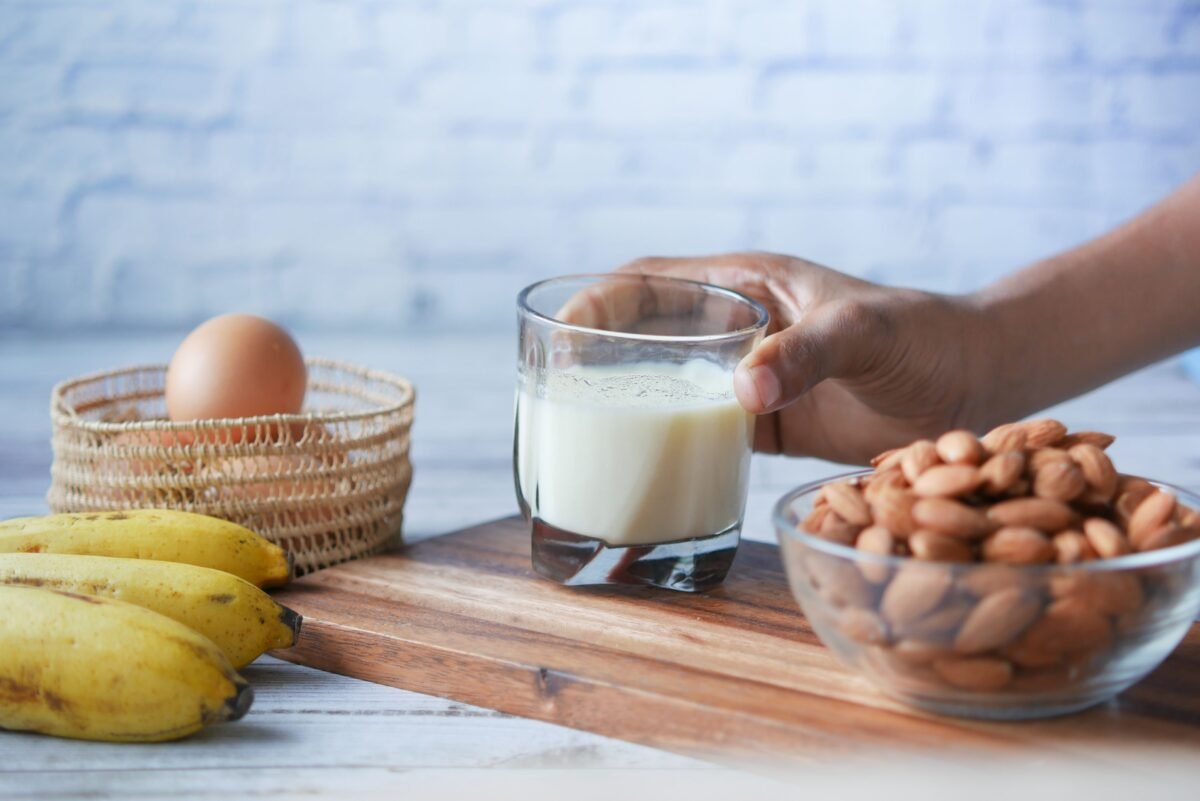
The official US Recommended Dietary Allowance (RDA) for adults is 0.8 g per kg of body weight per day, how much protein per day set by the National Academies and used for both men and women. It was built from nitrogen balance studies and is designed to meet the needs of nearly all healthy adults and prevent deficiency.
Three things are worth understanding about that number:
- It is a minimum, not a goal. The RDA answers “how little can I eat without losing protein from my body?” It does not claim to be the best intake for strength, healthy ageing or fat loss.
- It is about total protein, not food weight. 100 g of chicken is not 100 g of protein. It is roughly 25 to 31 g of protein (more on this below).
- It is not the same as the upper limit. The Dietary Reference Intakes also give an acceptable range of 10% to 35% of daily calories from protein for adults.
Many adults in high-income countries already eat more than the RDA without trying. If you eat a varied diet with meat, fish, eggs, dairy, legumes or soy at most meals, you may already be covering the basics. how much protein per day The groups who most often fall short are older adults with small appetites, people on very restrictive or low-calorie diets, people with limited access to protein foods and some vegetarians who rely mainly on bread and rice.
How to Calculate Your Daily Protein Requirement

You only need your weight and a multiplier.
In kilograms: body weight (kg) × 0.8 = grams of protein per day In pounds: body weight (lb) × 0.36 = grams of protein per day
To use a higher target, swap 0.8 for 1.0, 1.2, 1.6 and so on (or 0.45, 0.55 and 0.73 per pound).
Protein needs by body weight (kg and lb)
| Body weight | At 0.8 g/kg (RDA) | At 1.2 g/kg | At 1.6 g/kg | At 2.0 g/kg |
|---|---|---|---|---|
| 50 kg (110 lb) | 40 g | 60 g | 80 g | 100 g |
| 60 kg (132 lb) | 48 g | 72 g | 96 g | 120 g |
| 70 kg (154 lb) | 56 g | 84 g | 112 g | 140 g |
| 80 kg (176 lb) | 64 g | 96 g | 128 g | 160 g |
| 90 kg (198 lb) | 72 g | 108 g | 144 g | 180 g |
A worked example
Priya weighs 62 kg and walks daily but does not train. how much protein per day Her RDA is 62 × 0.8 = about 50 g. If she starts lifting weights three times a week and wants to build muscle, 62 × 1.6 = about 99 g is a reasonable target.
Mark weighs 180 lb. His RDA is 180 × 0.36 = about 65 g. If he is 67 and wants to protect his muscle, 82 kg × 1.0 to 1.2 = about 82 to 98 g is a more useful range.
Which weight should you use?
For most people, current body weight works. If you carry a lot of extra body fat, calculating from your current weight can give a very high number. how much protein per day In that case, many dietitians use a healthy or goal weight, or a range, so ask a registered dietitian if you are unsure. If you are underweight, use a weight that matches your healthy target.
Daily Protein Needs by Age and Life Stage

Children and teens
Children’s RDAs are set in grams per day and rise with age: roughly 13 g for ages 1 to 3, 19 g for ages 4 to 8 and 34 g for ages 9 to 13. Teen needs are higher, with differences by sex from about age 14. how much protein per day Most children in well-fed households get enough from regular meals. Do not give children protein shakes or powders unless a paediatrician or dietitian advises it.
Adults under 50
If you are healthy and not training for performance, 0.8 g/kg covers the basics, how much protein per day and aiming a little higher (around 1.0 to 1.2 g/kg) is common and safe for healthy people, especially if it helps you feel full or spread protein more evenly across the day.
Adults over 50 and older adults
The RDA of 0.8 g/kg is the same at every adult age, but some researchers and expert groups argue older adults do better on more. how much protein per day Reasons include anabolic resistance (older muscle responds less to the same amount of protein), age-related muscle loss (sarcopenia) and a higher risk of frailty. Commonly cited expert ranges are:
- About 1.0 to 1.2 g/kg/day for healthy older adults, especially over 65
- About 1.2 to 1.5 g/kg/day for older adults with acute or chronic illness
The evidence is not completely one-sided. Some trials found that high-protein diets did not preserve muscle in older adults who already ate enough protein. how much protein per day The strongest results come when adequate protein is combined with resistance exercise, and the biggest benefit goes to people who were eating too little. Older adults with kidney disease are a separate case (see the safety section).
Pregnancy and breastfeeding
The RDA rises to about 1.1 g/kg/day in pregnancy and about 1.3 g/kg/day while breastfeeding. For a 70 kg woman that is roughly 77 g in pregnancy and 91 g while breastfeeding. how much protein per day Needs rise most in the second and third trimesters. Your midwife, GP or obstetrician can adjust this for twin pregnancies, nausea, vegetarian diets or other situations. Do not start high-dose protein supplements in pregnancy without advice.
How Much Protein Do You Need for Your Activity Level?
Sedentary adults
Little structured exercise: 0.8 g/kg is the baseline. Many people feel better eating up to about 1.0 to 1.2 g/kg, but it is not required for health.
Regular exercise and strength training
If you lift weights or do hard sessions several times a week, a typical evidence-based range is about 1.2 to 2.0 g/kg. how much protein per day For muscle growth, studies suggest benefits level off around 1.6 g/kg, and some individuals may benefit up to about 2.2 g/kg. Going above that rarely adds extra muscle for most people.
Athletes and endurance training
Endurance athletes commonly aim for about 1.2 to 1.6 g/kg, with the higher end for heavy training blocks. how much protein per day Strength and power athletes sit toward 1.6 to 2.0 g/kg. Elite athletes and people in a calorie deficit sometimes go higher under the guidance of a sports dietitian.
A note on social media numbers
You may see “1 gram per pound of body weight” (about 2.2 g/kg) promoted online. For many people that is more than the research says is useful, and it can be hard to hit and costly. how much protein per day It is not dangerous for many healthy people, but it is not required either.
Protein Intake for Weight Loss and Muscle Gain
Weight loss
When you eat fewer calories, your body can lose muscle along with fat. A higher protein intake, commonly about 1.2 to 1.6 g/kg, combined with strength training helps protect muscle, and protein also tends to keep you fuller. how much protein per day Lean, active people in a deficit sometimes need more, but this should be personalised. Very low-calorie diets should be supervised by a clinician.
Muscle gain
To build muscle you need three things together: progressive resistance training, enough total calories and enough protein (about 1.6 g/kg for most people). Protein alone does not build muscle. If your training or calories are too low, extra protein will not make up for it.
How Much Protein Should You Eat at Each Meal?
Total daily protein matters most. Within that, spreading it out can help:
- Many guides suggest roughly 20 to 30 g per meal for adults, and 25 to 30 g is often suggested for older adults.
- Most of us eat very little protein at breakfast and a lot at dinner. Shifting 10 to 15 g to breakfast is an easy change.
- You do not need to “use it or lose it” within an hour. Your body keeps absorbing protein over several hours.
If you eat one large meal a day, you can still meet your needs, but it may be harder to reach higher targets comfortably.
Best High-Protein Foods and Serving Examples
The numbers below are approximate and vary by brand, cut and cooking method. how much protein per dayAlways check the nutrition label or a food database such as USDA FoodData Central.
| Food | Serving | Protein (approx.) |
|---|---|---|
| Chicken breast, cooked | 100 g (3.5 oz) | 28 to 31 g |
| Salmon, cooked | 100 g (3.5 oz) | 22 to 25 g |
| Eggs | 1 large | 6 g |
| Greek yogurt, plain | 170 g (3/4 cup) | 15 to 17 g |
| Cottage cheese | 1 cup | 24 to 28 g |
| Paneer | 100 g | 18 g |
| Milk | 1 cup (240 ml) | 8 g |
| Lentils (dal), cooked | 1 cup | 18 g |
| Chickpeas, cooked | 1 cup | 14 to 15 g |
| Kidney beans, cooked | 1 cup | 13 to 15 g |
| Firm tofu | 100 g | 8 to 12 g |
| Peanut butter | 2 tbsp | 7 g |
| Almonds | 30 g (a small handful) | 6 g |
| Whole-wheat roti / chapati | 1 medium | 3 to 4 g |
A sample day at about 90 g of protein
| Meal | What | Protein |
|---|---|---|
| Breakfast | 2 eggs, 1 slice whole-wheat toast, 1 glass of milk | about 24 g |
| Lunch | 1 cup lentil dal, 1/2 cup plain yogurt, 2 rotis | about 29 g |
| Snack | Small handful of almonds and an apple | about 6 g |
| Dinner | 120 g cooked chicken (or 150 g paneer), vegetables, rice | about 32 to 38 g |
| Total | about 91 to 97 g |
Vegetarian and vegan options
You can meet your needs without meat. Combine legumes (lentils, chickpeas, beans), soy products (tofu, tempeh, edamame), dairy or eggs if you eat them, nuts, seeds and whole grains across the day. Plant proteins can be slightly less digestible and lower in some essential amino acids, how much protein per day so vegans often aim for the upper part of their range (for example, closer to 1.0 g/kg in adults who are otherwise healthy) and include a variety of sources, such as soy, lentils and grains together. You do not need to combine them in the same meal.
Protein powders and supplements
Supplements are a convenience, not a requirement. A whey, casein or plant-based powder gives about 20 to 25 g per scoop. They can help if your appetite is small, you are recovering from illness or you have high athletic needs. how much protein per day Look for products tested by a third party, avoid mega-doses and check with your doctor if you have kidney, liver or metabolic conditions.
Signs You May Not Be Getting Enough Protein
A low intake can show up as:
- Ongoing muscle weakness or slow recovery from exercise
- Unintended weight or muscle loss
- Hair thinning, brittle nails or slow wound healing
- Frequent illness or swelling (oedema) in severe cases
- Constant hunger shortly after meals
These signs have many other causes. If you notice them, see a doctor instead of simply adding more protein.
Can You Eat Too Much Protein?
For most healthy people, eating more than the RDA is considered safe, how much protein per day and intakes up to about 2.0 g/kg are common in athletes. The picture is different in a few cases.
- Kidney disease: People with chronic kidney disease may need to limit protein, sometimes to around 0.6 to 0.8 g/kg, under the care of a nephrologist or renal dietitian. Do not increase your protein if you have kidney problems without medical advice.
- Crowding out other foods: A diet that is very high in protein can leave little room for fibre, fruit, vegetables and whole grains.
- Red and processed meat: If much of your protein comes from processed meats, you may raise your risk of some chronic conditions. Favour fish, poultry, eggs, dairy, legumes and soy.
- Digestive effects: Sudden jumps in protein or supplements can cause bloating, constipation or diarrhoea. Drink enough water and add fibre.
- Cost and waste: Protein beyond what you need is used for energy or stored as fat; it does not all become muscle.
- Supplement quality: Some powders may contain heavy metals or added sugars. Choose reputable, third-party-tested brands.
Who Should Ask a Healthcare Professional About Protein Intake?
Speak with a doctor or registered dietitian before changing your protein intake if you:
- Have kidney disease, liver disease, or a metabolic or genetic condition affecting protein
- Are pregnant, breastfeeding or planning pregnancy and have special risks
- Are over 65 with unplanned weight loss, frailty or poor appetite
- Have diabetes or take medication that affects kidney function
- Have an eating disorder or a history of one
- Are a competitive athlete or are planning a large calorie deficit
- Are feeding a child with allergies or restricted eating
Common Mistakes When Setting a Protein Target
- Confusing food weight with protein weight. 200 g of steak is not 200 g of protein.
- Copying a gym influencer’s number. Your target should match your body, training and health.
- Using the RDA as an ideal. It is the minimum for deficiency prevention.
- Eating all protein at dinner. Spread it across meals where possible.
- Ignoring calories and training. Protein supports muscle, but it does not replace exercise or energy.
- Forgetting fibre and variety. Aim for protein-rich foods that also give vitamins, minerals and fibre.
- Using supplements instead of food. Whole foods bring other nutrients.
- Not tracking even briefly. Logging your food for 3 to 5 days gives a realistic baseline.
Frequently Asked Questions
How much protein per day should I eat?
Most healthy adults need at least 0.8 g per kg of body weight (0.36 g per lb), so about 56 g for a 70 kg adult. People who exercise, are older or are losing weight often aim for 1.0 to 2.0 g/kg depending on their situation.
How do I calculate protein per day by weight?
Multiply your weight in kilograms by 0.8 (or by 1.2 or 1.6 for higher targets). In pounds, multiply by 0.36 for the RDA. For example, 70 kg × 0.8 = 56 g.
Is 100 grams of protein a day enough?
It depends on your weight and goals. For a 70 kg adult, 100 g is about 1.4 g/kg, which is above the RDA and fits many active adults. For a 100 kg strength athlete it may be on the low side, and for a 50 kg sedentary adult it is more than the RDA.
Do I need more protein as I get older?
Many expert groups suggest 1.0 to 1.2 g/kg for healthy adults over 65, and up to 1.2 to 1.5 g/kg for those with chronic illness. Pair protein with resistance exercise for the best results, and check with your doctor if you have kidney problems.
How much protein do I need to build muscle?
Most research points to about 1.6 g/kg as the level where gains plateau for many people, with some benefit up to about 2.2 g/kg. You also need progressive training and enough calories.
How much protein should I eat to lose weight?
About 1.2 to 1.6 g/kg is commonly suggested to help preserve muscle and manage hunger during a calorie deficit. Pair it with strength training and get personalised advice if you have a health condition.
Final Thoughts
The short answer to “how much protein per day?” is: start with 0.8 g/kg as your floor, then adjust for your age, activity, goals and health. Work out your number from the tables above, spread it across your meals, build it from a mix of whole foods, and keep your overall diet balanced. If you have a medical condition or are unsure, a registered dietitian can turn these ranges into a plan that fits you.




One Comment